
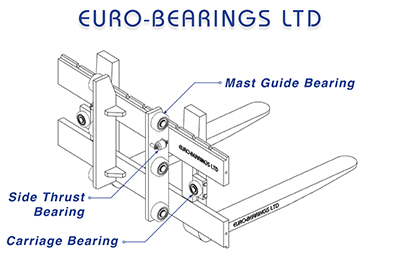
Forklift mast bearings play a vital role in the safe and efficient operation of every forklift truck. They support the movement of the mast, guide the carriage, and allow loads to be lifted smoothly while withstanding extremely high operating forces.
Whether you’re replacing worn bearings, servicing a forklift, or sourcing replacement parts, correctly identifying a mast bearing is essential. Ordering the wrong bearing can lead to costly downtime and unnecessary delays.
This guide explains the different types of forklift mast bearings, their key features, and the information you’ll need to identify the correct replacement.
What Are Forklift Mast Bearings?
Unlike standard industrial bearings that rotate at high speeds, forklift mast bearings are designed to roll linearly along the mast channels as the forks are raised and lowered. They experience high loads, impact forces, and constant movement, making them a specialist bearing designed specifically for forklift applications.
These bearings help to:
- Support the fork carriage during lifting.
- Guide each mast stage as it extends.
- Minimise friction between moving mast sections.
- Maintain stability when handling heavy loads.
The Four Main Types of Forklift Mast Bearings
Understanding the type of bearing fitted to your forklift is the first step in identifying the correct replacement.
1. Mast Guide Bearings
Mast guide bearings guide the mast sections as they extend during lifting. They carry substantial vertical loads and ensure the mast moves smoothly without excessive play.
2. Carriage Bearings
Carriage bearings provide guidance for the fork carriage as it travels up and down the mast. These bearings are generally smaller than mast guide bearings but are equally important for maintaining smooth operation.
3. Side Thrust Rollers
Side thrust rollers absorb sideways forces that occur during operation. They help prevent mast twist and improve stability, particularly when carrying offset or uneven loads.
4. Chain Roller Bearings
Chain roller bearings guide the lift chains that raise and lower the mast. Their flanged design helps keep the chains correctly aligned during operation.
Some forklifts also use combined roller assemblies, where a mast guide bearing and side thrust roller are incorporated into a single unit.
How to Recognise a Forklift Mast Bearing
Forklift mast bearings have several distinctive characteristics that separate them from standard ball bearings.
- Thick Outer Ring
One of the easiest ways to identify a mast bearing is its unusually thick outer ring. Because the bearing runs directly along the mast rail, the outer ring must withstand heavy loads and repeated impact. - Sealed Construction
Most mast bearings are sealed to retain grease and prevent dirt, dust and moisture from entering the bearing. Depending on the application, seals may be rubber, metal, or a combination of both.
- One-Piece Assembly
Unlike many standard bearings, mast bearings are manufactured as an inseparable assembly, providing strength and durability in demanding working environments.
- Ball or Roller Design
Depending on the application, the internal rolling elements may be either balls or rollers, allowing the bearing to cope with the significant loads encountered during forklift operation.
Information Needed to Identify a Forklift Mast Bearing
If you’re trying to source a replacement bearing, gathering accurate information will make identification much easier.
- Forklift Make and Model
Knowing the manufacturer and model of the forklift is often the quickest starting point. Many bearing designs are specific to particular makes and mast configurations. - Part Numbers
Check the bearing itself for any stamped numbers, manufacturer markings, or identification codes. If available, a parts manual reference can also be extremely helpful. - Bearing Dimensions
Accurate measurements are critical.
Important dimensions include:
– Internal diameter (shaft size)
– Outside diameter
– Outer ring width
– Inner ring width
For side thrust rollers, additional measurements such as shaft length and hole centres may also be required. - Bearing Style
Photographs can often assist identification. The overall shape, sealing arrangement, and whether the bearing contains balls or rollers can all help determine the correct replacement. Alternatively use our drawing index to highlight the important features.
What If the Bearing Is Obsolete?
Finding a replacement for an obsolete forklift mast bearing can be challenging, particularly for older trucks or specialist applications. Fortunately, an obsolete bearing doesn’t always mean your equipment has reached the end of its service life.
At Euro-Bearings Ltd, we can manufacture bespoke mast bearings to suit your specific requirements. Whether the original bearing is no longer in production or you need a custom solution, our experienced team can help.
In most cases, we simply require a sample bearing or drawing to produce an accurate quotation. Thanks to our efficient manufacturing capabilities, lead times can be as short as 24 hours, helping to minimise downtime and get your forklift back into operation as quickly as possible.
If you’re struggling to identify or source a replacement mast bearing, contact the Euro-Bearings team for expert advice and a bespoke solution tailored to your application.
Need Help Identifying Your Mast Bearing?
Identifying forklift mast bearings doesn’t have to be difficult when you know what information to collect. By recording the forklift make, part numbers, dimensions and bearing style, you can significantly speed up the identification process and ensure the correct replacement is supplied.
At Euro-Bearings, our technical team has decades of experience identifying mast guide bearings, carriage bearings, side thrust rollers and chain roller bearings for a wide range of forklift manufacturers. Whether you require a standard replacement or a bespoke bearing for an obsolete application, we’re here to help.
Visit our forklift mast bearing guide or contact our technical sales team for expert assistance in identifying the correct bearing for your forklift.