In manufacturing, achieving a secure fit between components is rarely as straightforward as it seems. Variations in machining, material properties, thermal expansion, and assembly processes can all affect the performance of an interference fit. That’s where tolerance rings come in.
Tolerance rings provide a simple, cost-effective way to compensate for manufacturing tolerances while securely retaining components and transmitting torque.
What Is a Tolerance Ring?
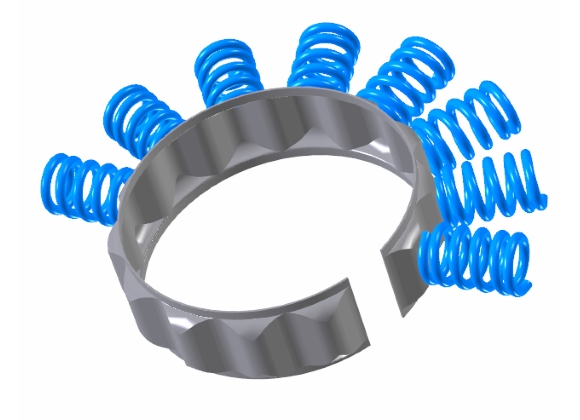
A tolerance ring is a precision-engineered stainless steel ring featuring a series of corrugations (or “waves”) around its circumference that create controlled radial forces when installed between two components.
These corrugations act like springs, allowing the ring to absorb dimensional variations while maintaining a secure fit. Tolerance rings are effective alternative to traditional press-fit assemblies, adhesives, and mechanical fasteners.
Are There Different Types of Tolerance Rings?
Tolerance rings come in three main forms: AN, BN and AL.
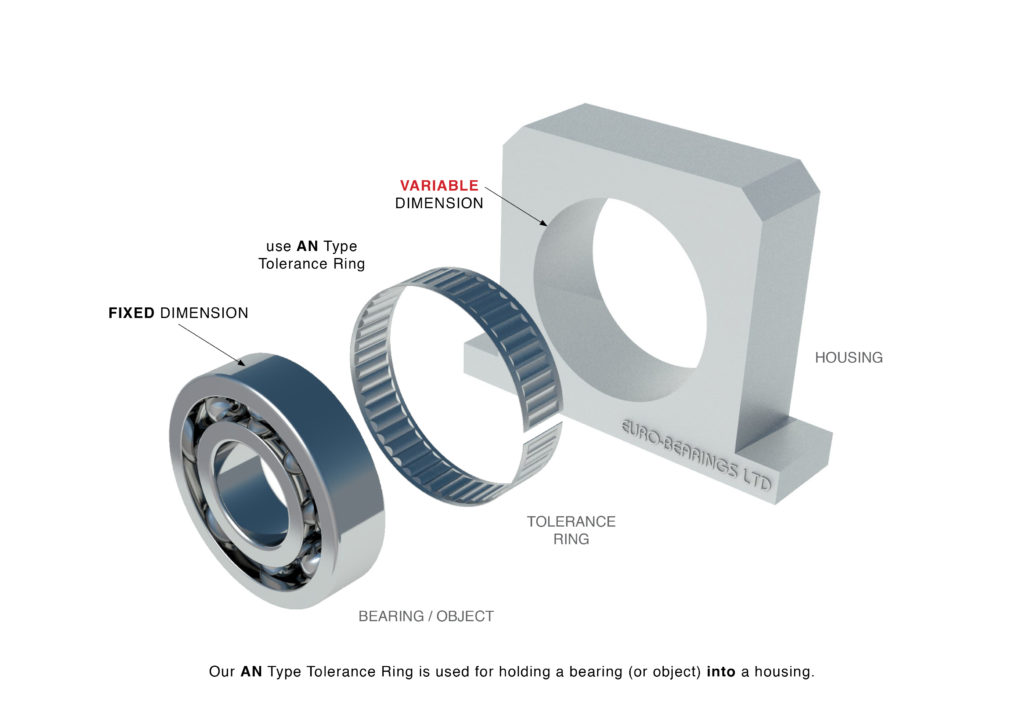
AN – The AN tolerance rings are fitted to the outside diameter (OD) of a bearing and the housing dimenison is varied to suit the tolerance ring. The corrugations face inwards.
BN – The BN tolerance rings are fitted to the inside diameter (ID) of a bearing and the shaft size is varied to suit. The corrugations face outwards.
AL – The AL type are significantly thinner and are flat or slightly curved. They are suitable for lighter duty applications and fit to the OD of a bearing. The outward corrugations are less pronounced.
How Do Tolerance Rings Work?
When a tolerance ring is installed, the corrugations compress and generate radial pressure. This pressure creates friction that holds components in place and enables torque transmission.
The flexibility of the ring allows it to accommodate dimensional differences, maintaining consistent performance even when manufacturing tolerances vary.
Key Benefits
– Reduced Manufacturing Costs
Tolerance rings allow for wider component tolerances, reducing machining requirements and lowering production costs.
– Easier Assembly
Compared with traditional press fitting, tolerance rings require a lower installation force, helping prevent component damage during assembly.
– Vibration and Noise Reduction
The spring characteristics of tolerance rings help absorb vibration and reduce noise, making them ideal for rotating equipment and electric motors.
– Improved Serviceability and Disassembly
Unlike adhesives, tolerance rings can often be removed and replaced without damaging surrounding components.
Common Applications
Tolerance rings are used across a wide range of industries, including:
- Electric motors
- Automotive systems
- Pumps and fans
- Robotics
- Medical devices
- Consumer electronics
- Electric vehicles
They are particularly valuable in applications where manufacturers need to balance performance, cost, and ease of assembly.
Conclusion
As manufacturers strive for greater efficiency and reliability, tolerance rings offer a proven solution for accommodating dimensional variation. Their ability to provide secure retention, transmit torque, and reduce assembly complexity makes them a valuable component in modern engineering design.