How to Choose the Right Linear Bearing System

Choosing the right linear bearing system is essential for reliable, accurate and long-lasting linear motion. But with several different technologies available, selecting the right solution isn’t always straightforward.

Linear bearings, motion guidance, vee bearings, track guidance and combined roller bearings each have different characteristics and advantages. The best choice will depend on factors such as load, speed, accuracy, operating environment, available space and the design of the application.

At Euro-Bearings, we supply all five types of linear motion products and can help customers select the most appropriate system for their application.

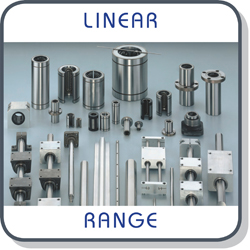
1. Linear Bearings

Linear bearings, or ball bushings, are a well-established solution for linear movement. They typically run on hardened and ground round shafts, with recirculating balls providing smooth, low-friction movement.
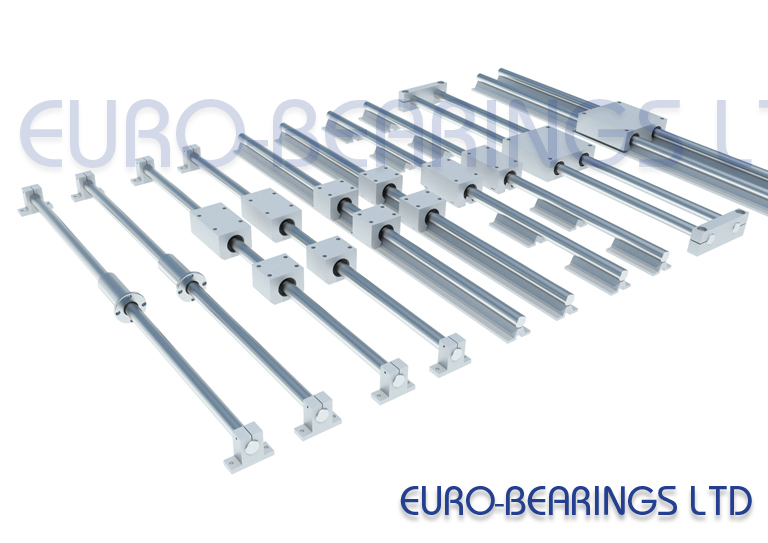
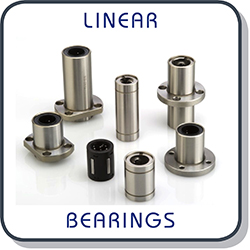
linear bearings, housings and shafts

They are a popular choice for applications requiring:

  • Smooth, low-friction movement
  • Good accuracy
  • High travel speeds
  • Compact installation
  • Cost-effective linear motion

Linear bearings are widely used in automation, machinery and general industrial applications.

For applications where the load, environment and accuracy requirements are relatively straightforward, a conventional linear bearing can provide an economical and effective solution. Stainless steel options are available.

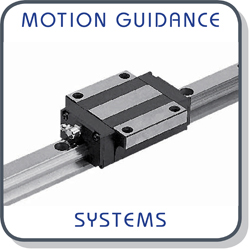
2. Motion Guidance Systems

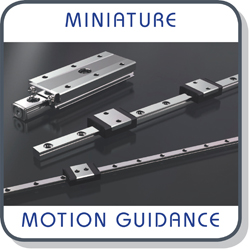
Motion guidance systems use a carriage running along a profiled rail. Unlike a conventional linear bearing running on a round shaft, the carriage and rail form an integrated linear guide system.

Recirculating balls run along precision raceways in the profiled rail, providing smooth and accurate movement with high rigidity.

Motion guidance systems are particularly suited to applications requiring:

  • High accuracy
  • High stiffness
  • Smooth movement
  • Good load capacity
  • The ability to accommodate moment loads
  • Compact linear guidance
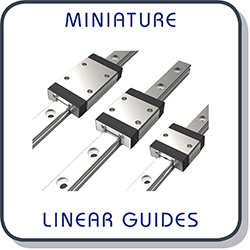
linear motion guidance with profiled rail

They are commonly used in automation, machine tools, positioning systems and other applications where precise linear movement is important.

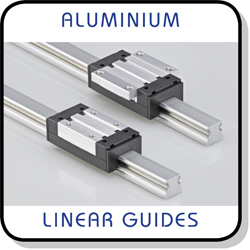
The profiled rail provides a rigid and accurate guidance surface, while the carriage can be mounted directly to the moving component. For precision applications, a motion guidance system may therefore be preferable to a conventional ball bushing and shaft arrangement. Also available in aluminium for applications requiring corrosion resistance.

3. Vee Bearings

Vee bearings use a V-shaped running surface that engages with a matching Vee rail or track.

This provides a simple and versatile approach to linear guidance and can be particularly useful in industrial environments where robustness and resistance to contamination are important.
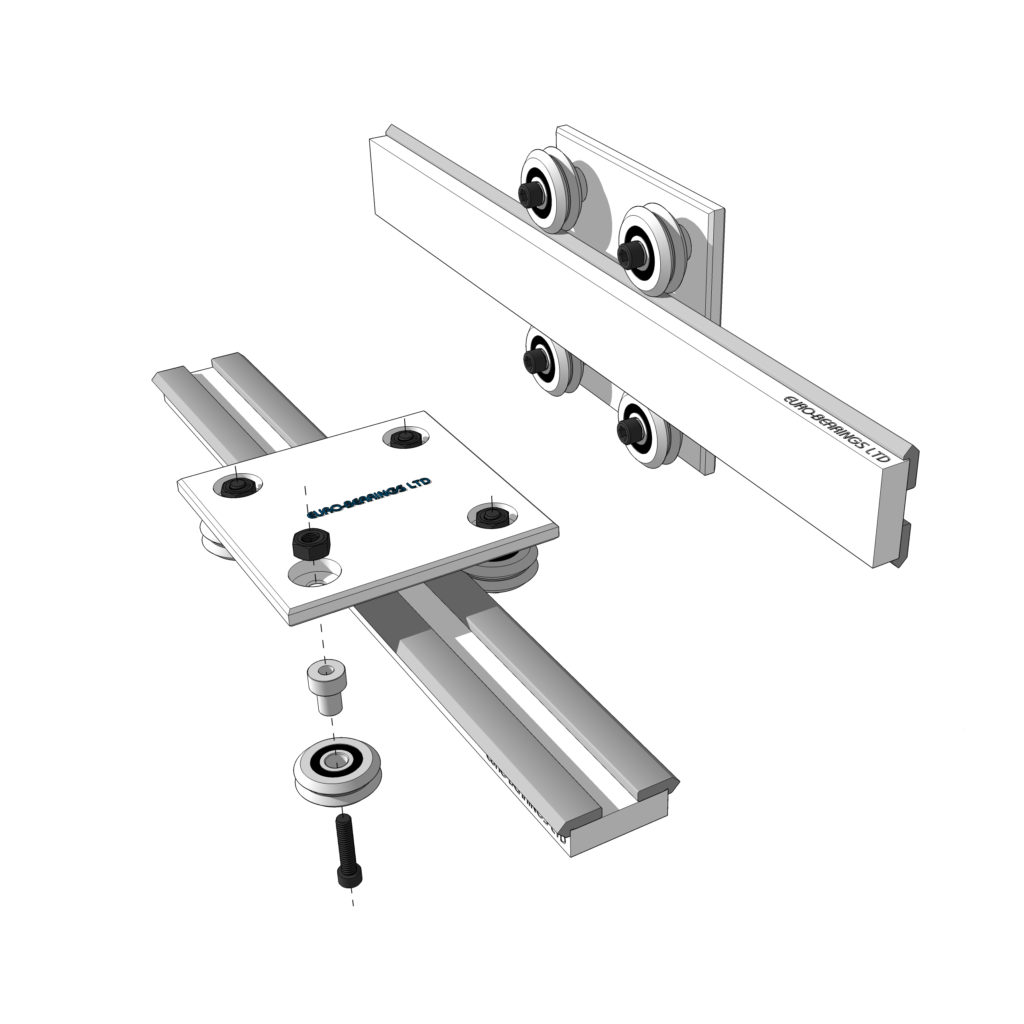
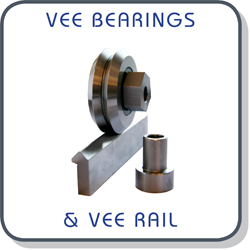
Vee bearings for linear motion

Vee bearing systems can offer:

  • Robust construction
  • Good load capacity
  • Low friction
  • Long travel capability
  • Resistance to contamination
  • Flexible mounting options

One of the main advantages of Vee bearing systems is their flexibility. The rails can often be incorporated directly into the machine structure, allowing the guidance system to be designed around the application.

Vee bearings are suitable for a wide range of applications, including machinery, automation and material handling. They can be particularly attractive where a robust and relatively simple guidance system is required. Both steel and stainless steel options are available.

4. Track Guidance

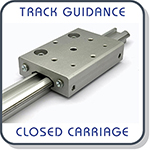
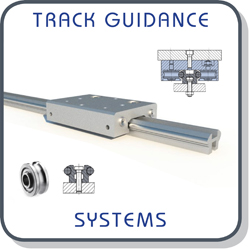
Track guidance systems provide smooth and accurate linear movement using track bearings running along precision-ground rails. A key advantage of this system is the use of fully sealed, double-row ball bearings, which are much less susceptible to contamination than open recirculating-ball systems.

This makes track guidance particularly interesting for industrial applications where dust, dirt or other contaminants could affect conventional linear guidance.

The system combines an anodised aluminium extrusion with a steel or stainless-steel shaft, providing a lightweight yet robust guideway. Both open and closed carriage designs are available, giving engineers flexibility when integrating the system into a machine.

Track guidance systems can be used in a wide range of applications, including:

  • Automation
  • Industrial machinery
  • Measuring devices
  • Long-travel systems
  • Applications exposed to contamination
Track guidance linear motion

The track bearings are sealed for life, while the carriage can incorporate lubrication and wiper elements to help keep the guideways clean and lightly lubricated.

For applications requiring corrosion resistance, the system can also be specified with stainless-steel bearings and shafts.

With its combination of sealed bearings, precision-ground running surfaces and lightweight aluminium guideways, track guidance provides a durable and versatile solution for industrial linear motion which is quick and easy to install.

5. Combined Roller Bearings

Combined roller bearings provide a robust solution for heavy-duty linear motion and are particularly useful where high loads and forces in different directions need to be accommodated.

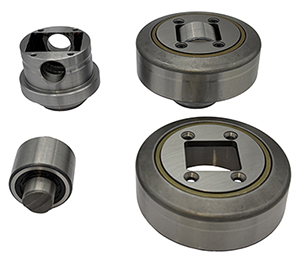
A combined roller bearing incorporates radial and axial rollers in one unit. The radial roller carries the principal load, while the axial roller provides lateral guidance against the rail.

This allows the bearing to support the load while simultaneously controlling the movement of the carriage.
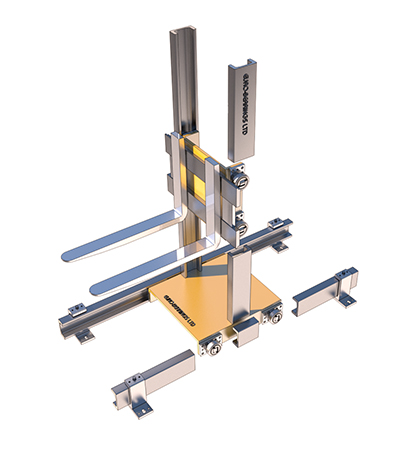
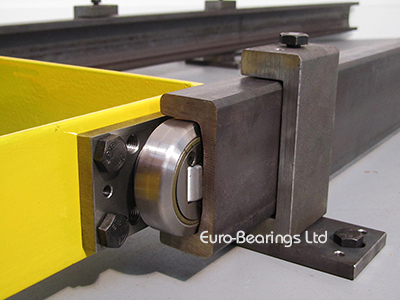
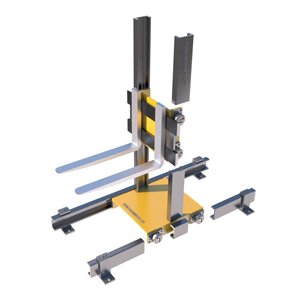
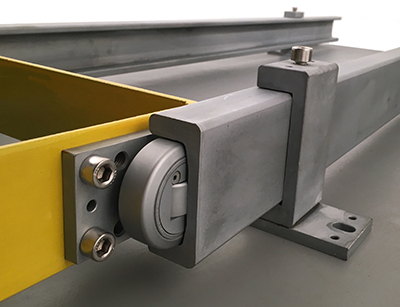
combined roller bearing application

Combined roller bearings are particularly useful for:

  • Heavy loads
  • Radial, axial and moment loading
  • Cantilevered applications
  • Horizontal and vertical movement
  • Telescopic systems
  • Harsh industrial environments

A key advantage is their tolerance of dirt and contamination. Their robust construction makes them particularly suitable for industrial applications where dust, dirt and other contaminants could affect more sensitive linear guidance systems.

They can be used with profiled steel rails in horizontal, vertical and telescopic arrangements. A simple system can consist of two rails and four bearings, while more complex configurations can be designed for larger loads and longer travel.

Euro-Bearings has extensive experience with combined roller bearing systems and can assist with bearing selection, load calculations, rail configuration and bearing spacing.

Key Benefits at a Glance

Each linear bearing system has its own strengths:

  • Linear bearings: smooth, economical and well suited to general-purpose applications.
  • Motion guidance: high precision, rigidity and accuracy.
  • Vee bearings: robust, compact and resistant to contamination.
  • Track guidance: durable, quick to install and well suited to long-travel industrial applications.
  • Combined roller bearings: heavy duty, multi-directional load capability and excellent tolerance of dirt and contamination.

The most suitable system will depend on the specific requirements of the machine, including its load, speed, accuracy and operating environment.

What Should You Consider When Selecting a System?

Before choosing a linear bearing system, consider five key factors.

  • Load

Determine the total load and how it will be distributed across the bearings. Off-centre and cantilevered loads can create significant moments and change the load carried by individual bearings.

  • Speed and Duty Cycle

Consider the maximum speed, acceleration, travel distance and number of cycles. A system designed for occasional movement may not be appropriate for continuous, high-speed operation. Recirculating ball bearings are capable of higher speeds than track bearings.

  • Accuracy

How accurately does the moving component need to be guided?

For precision positioning, a profiled motion guidance system or linear bearing may be appropriate. For less demanding applications, track bearings may provide a more economical solution.

  • Operating Environment

Dust, dirt, moisture and other contaminants can have a major effect on bearing performance.

In a clean environment, a conventional linear bearing or motion guidance system may be ideal. For harsher industrial environments, Vee bearings, track guidance or combined roller bearings may be more appropriate.

  • Space and Installation

Consider the available space, mounting surfaces, alignment requirements and future maintenance.

The most suitable system isn’t necessarily the smallest or cheapest bearing. The complete installation, including the rail or shaft and mounting arrangement, needs to be considered.

Choose the Right Solution with Euro-Bearings

Selecting a linear bearing system can be challenging when an application has unusual loads, limited space or demanding operating conditions.

Euro-Bearings supplies a comprehensive range of linear motion products, including linear bearings, motion guidance systems, Vee bearings, track guidance and combined roller bearings.

Our technical team can help with product selection and application advice, whether you are designing a new machine or replacing an existing bearing.

If you’re unsure which system is right for your application, contact Euro-Bearings with details of the load, speed, travel, operating environment and available space. If you’re replacing an existing component, photographs, dimensions or the original part number can also help us identify a suitable solution.

From precision motion guidance to heavy-duty combined roller bearing systems, Euro-Bearings can help you select the right linear motion solution for your application.
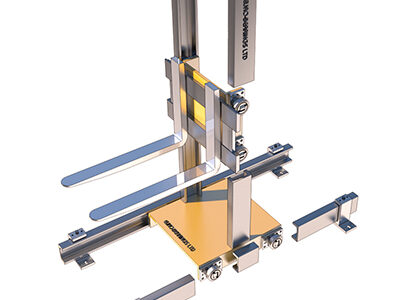
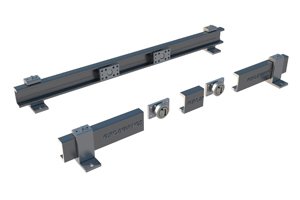
Four Bearings, Two Rails, 50 Tonnes: The Engineering Behind It

combined roller bearing application

At first glance, a heavy-duty linear motion system can look surprisingly simple – just two rails and four combined roller bearings to make a moving system.

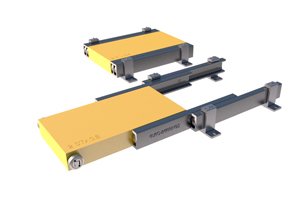
horizontal linear motion application

Surely that’s too simple to move a load weighing several tonnes, let alone tens of tonnes. Yet this basic arrangement is at the heart of some remarkable linear motion systems.

So what is going on? The answer is load management.

It’s not just about carrying the weight

When we think about a linear bearing, it is tempting to only think about load capacity. If a carriage weighs 10 tonnes, surely the solution is to simply specify bearings capable of carrying 10 tonnes?

Not quite. In a linear motion system, the bearings can be dealing with several different forces at the same time. There may be a vertical load from the weight of the equipment, horizontal forces from wind or wave loading, forces from asymmetric loading and moments created by a cantilevered arrangement.

That’s where the combined roller bearing comes into its own. It incorporates radial and axial rollers in a single unit. The radial roller carries the principal load while the axial roller provides lateral guidance against the web of the rail.

The result is a compact bearing that can both support a load and guide the movement.

Why two rails and four bearings work so well

The classic arrangement uses two parallel rails with two combined roller bearings running inside each rail.

The radial rollers run along the flange of the rail, supporting the main load. The axial rollers run against the web of the rail, controlling lateral movement.

The lateral guidance provided by the axial roller ensures the carriage moves smoothly forwards and backwards and prevents it from moving sideways (“crabbing”) as it travels.

So, although there are only four bearings, each bearing is doing more than simply carrying a proportion of the weight. Each bearing unit works to provide both load support and guidance.

And that’s where the engineering gets interesting.

The Centre of Gravity changes everything

If the load is located in the middle of the four bearings, the forces will be distributed relatively evenly.

Now move the load towards one end. The weight hasn’t changed, and the bearings haven’t changed, but the forces within the system have.

The offset load creates a moment, increasing the load on some bearings while reducing it on others. In cantilevered applications, where the centre of gravity extends beyond the bearings, the additional loads can be significant.

The obvious solution is to increase the size of the bearings to accommodate these additional forces. However, the location of the bearings plays an equally important role in the design. Increasing the distance between the bearings helps to manage the cantilevered load by providing a larger opposing moment arm. Optimising the bearing arrangement can therefore be a better solution when space, weight and cost are critical.

It’s all about Contact Pressure

Another important consideration is the contact between the combined roller bearings and the rail.

The bearing may have an impressive load rating, but the capacity of the system is actually limited by the rail. The forces on the bearings have to be transferred to the rail through relatively small contact areas. This is where Hertzian contact pressure becomes important.

Designing the system therefore involves looking at the load capacity of the bearings when used in conjunction with the rails. The number of bearings, bearing spacing, rail size, applied load and load distribution all have an influence on the contact pressure.

The allowable Hertzian pressure is determined by the steel grade of the rails.

Four bearings can be remarkably versatile

horizontal and vertical system
Combined roller bearings can be used horizontally and vertically

The beauty of the two-rail, four-bearing arrangement is that it can be used in any orientation.

Turn the system on its side and it can provide horizontal linear movement.

Use it vertically and it can support lifting mechanisms (think forklift trucks).

Extend the rails and bearings into a telescopic arrangement and it can offer a full pull-out in a surprisingly compact space.

Introduce a cantilevered load and the same basic principles of bearing spacing, load distribution and moment balance still apply.

Telescopic heavy duty linear motion
This telescopic system allows full extension


The same components can be optimised for each application through careful engineering. This is one of the reasons combined roller bearings are used in such a wide range of machinery – from material handling and automation equipment to lifting systems and heavy industrial applications. View our range of application examples.

And then things get really big

One of the most incredible things about combined roller bearing systems is how far the same basic engineering principle can be scaled. From the smallest 52.5mm diameter bearing to the largest 390mm “Jumbo” bearing, the concept remains the same.

This simple arrangement was used in a cantilevered lifting mechanism to move the 50-tonne wing of an Airbus A380. That’s quite a leap from the simple four-bearing arrangement we started with.

Simple doesn’t mean unsophisticated

Sophisticated machinery doesn’t require complicated components.

Combined roller bearings handle both radial and axial loads in a single unit. They provide a robust linear motion system which can be engineered to suit a variety of applications.

Two rails and four bearings may not look particularly complicated, but when you start considering radial loads, axial guidance, moment loads, bearing spacing and contact pressure, there’s considerably more going on than first meets the eye.

And that’s the clever part – the performance comes from getting the engineering fundamentals right, not from overcomplicating the system.

For applications where reliable, heavy-duty linear movement is required, that combination of simplicity, scalability and load-handling capacity is what makes combined roller bearings such an effective solution.

How Euro-Bearings can help

Getting the bearing arrangement right starts with understanding the application.

Euro-Bearings can help you work through the engineering requirements, from load and moment calculations to bearing selection, rail configuration and bearing spacing. There’s also an online calculator to guide you together with plenty of application examples.

Whether you’re designing a new linear motion system or looking to improve an existing one, our technical team can help identify a combined roller bearing solution suited to the loads and operating conditions involved.

With a broad range of standard and specialist bearings, rails and accessories available, Euro-Bearings can provide both the components and the engineering knowledge to help turn the concept into a practical linear motion system.

Stainless Steel Linear Bearings and Guides

Euro-Bearings Ltd stocks a wide range of linear motion products. We are able to offer a variety of products in stainless steel when corrosion resistance is required. Our technical sales team have many years of expertise and are able to guide you with selecting the best product for your application.
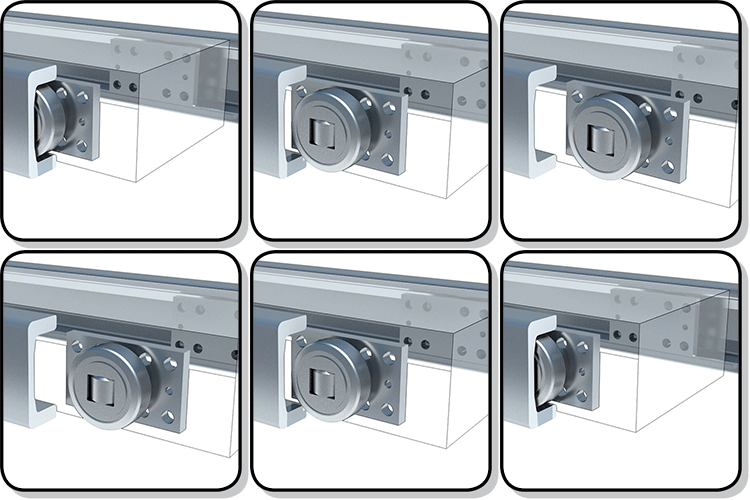
Stainless Steel Linear Bearings and Stainless Steel Shafts:

These linear bearings offer high corrosion resistance due to the special characteristics of martensitic stainless steel. The hardening process leads to an increased service life and a higher load capacity.

The linear bearings are available in closed (KB50) and open (KB53) types along with a range of round flanged versions including FK10 (standard length), FK90 (tandem length) and TF00 (centre flanged).

In addition to this, the SK-n super ball bushings and CLBn compact ball bushings are available with electroless nickel coating to the bush and stainless steel balls. Alternatively the LBBRn is a stainless steel linear bearing with compact design.

The X90CrMoV18 stainless steel shafts are hardened and polished linear bearing shafts, and are available from ø3mm to ø50mm. They can be supplied cut to length or machined to your requirements.

Stainless Steel Linear Guide Rails:

The profiled rail linear guides of the motion guidance systems offer high precision and smooth operation.

All of the Miniature Motion Guidance range (sizes 7 to 20) are made from stainless steel as standard.

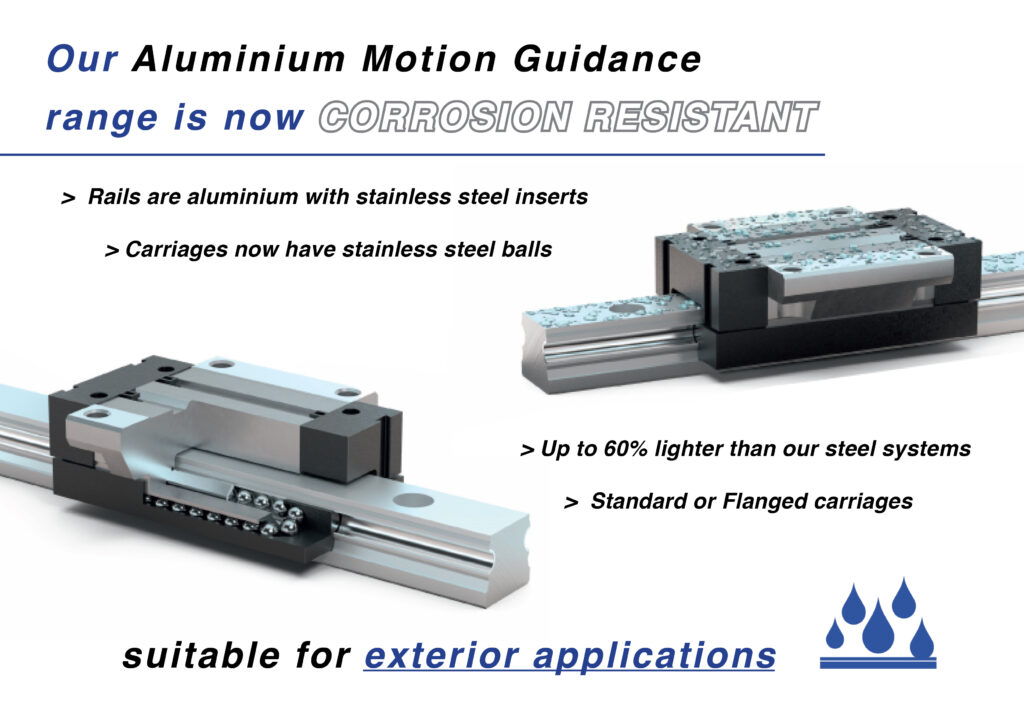
The Aluminium Motion Guidance range is also corrosion resistant as the raceways and balls are made from stainless steel. It is available in sizes 15, 20 and 25.

Track guidance linear motion

The Track Guidance System can also be supplied as corrosion resistant – the carriages can be supplied with stainless steel bearings and the rails with stainless steel shafts.

Stainless Steel Spline Nuts and Shafts:

The SSP and SPF spline nuts can be supplied in stainless steel with a resin cage, for diameters up to 25mm. The ground spline shaft is available in stainless steel for the corresponding sizes. Other diameters are available with black chrome plating on request.

Stainless Steel Vee Bearings:

When used in conjunction with the Vee rail and Vee bushings, the Vee bearings linear system is suitable for harsh environments with high speed capabilities, medium accuracy and low noise. The Vee bearings, Vee bushes and Vee rails are all available in stainless steel.

Corrosion Resistant Combined Roller Bearings and Rails:

combined roller bearing with TDC coating

For heavy duty linear motion applications, Euro-Bearings Ltd’s Combined Roller Bearings are often the best solution.

The bearings can be Thin Dense Chromium (TDC) coated to provide corrosion resistance and the rails can either be TDC coated for maximum protection, or galvanised / painted. If the rails are galvanised or painted, the surface of the rail in contact with the bearing must remain free of coating to preventing flaking. The standard combined roller bearings are available from ø52mm to ø149mm, with sizes up to ø390mm in the Jumbo range. The rails are available in C or I sections and are cut to the required length.

The bearings and rails can be configured for vertical, horizontal or cantilevered applications and can be used to make telescopic arrangements too. Example arrangements can be found on our website. This system is particularly tolerant of dirt as the bearings are sealed.

Conclusion:

With a wide range of corrosion resistant linear bearings to choose from, you can be certain to find something suitable for your linear motion application. Our technical sales are always happy to help, so please call or email to discuss.

Corrosion Resistant Linear Motion System

Our aluminium motion guidance system is now fully corrosion resistant. The profiled linear rails are made from aluminium with stainless steel inserts and the carriages have stainless steel balls. The carriages are available in standard and flanged styles and there are three sizes available. The rails can be specified as either top or bottom mounting. This lightweight system is ideal for exterior applications or where there is a requirement for low ferrous content.

A Quick Guide to Choosing the Best Linear Motion Product

There is a vast range of linear motion products on the market and it can be difficult to know which product to select. This article discusses the various types of products available according to their rolling element and explores their advantages, disadvantages and limitations. Finally a selection chart clearly lists each product’s characteristics to help with specifying the best linear motion product.

Some of our linear motion products are shown in the table below:

Linear Bearings, Housings, Shafts & Supports Heavy Duty Rollers (NUTR, NUKR, NNTR) Vee Bearings Motion Guidance Systems (Standard & Aluminium)
Miniature Motion Guidance Track Guidance System Combined Roller Bearings Plain Sliding Linear Bearings

What are Linear Motion Products?

 The primary purpose of linear motion products is to move something from one place to another in one direction along a straight line. Usually this is achieved using a bearing with a rolling element. Traditionally this rolling element would be a ball or roller, but these days some linear motion bearings do not incorporate a rolling element and consequently are known as ‘plain’ bearings. These plain bearings are simply plastic or ceramic bushes and are sometimes lined with PTFE or oil impregnated plastic to help reduce the sliding friction. Continue reading →