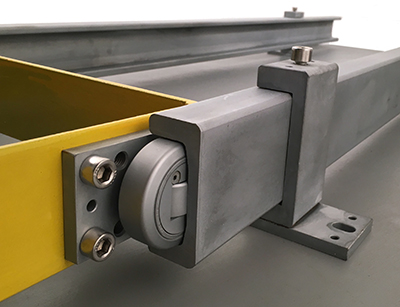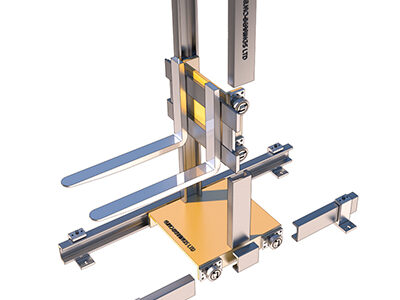
At first glance, a heavy-duty linear motion system can look surprisingly simple – just two rails and four combined roller bearings to make a moving system.
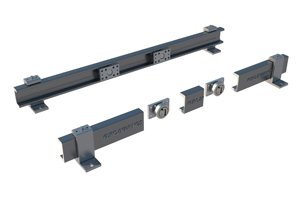
Surely that’s too simple to move a load weighing several tonnes, let alone tens of tonnes. Yet this basic arrangement is at the heart of some remarkable linear motion systems.
So what is going on? The answer is load management.
It’s not just about carrying the weight
When we think about a linear bearing, it is tempting to only think about load capacity. If a carriage weighs 10 tonnes, surely the solution is to simply specify bearings capable of carrying 10 tonnes?
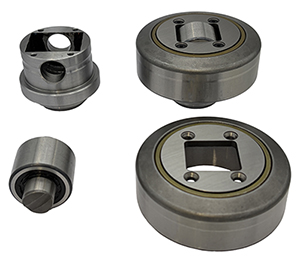
Not quite. In a linear motion system, the bearings can be dealing with several different forces at the same time. There may be a vertical load from the weight of the equipment, horizontal forces from wind or wave loading, forces from asymmetric loading and moments created by a cantilevered arrangement.
That’s where the combined roller bearing comes into its own. It incorporates radial and axial rollers in a single unit. The radial roller carries the principal load while the axial roller provides lateral guidance against the web of the rail.
The result is a compact bearing that can both support a load and guide the movement.
Why two rails and four bearings work so well
The classic arrangement uses two parallel rails with two combined roller bearings running inside each rail.
The radial rollers run along the flange of the rail, supporting the main load. The axial rollers run against the web of the rail, controlling lateral movement.
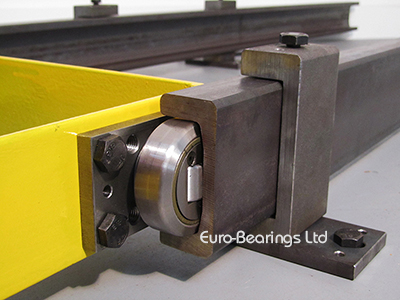
The lateral guidance provided by the axial roller ensures the carriage moves smoothly forwards and backwards and prevents it from moving sideways (“crabbing”) as it travels.
So, although there are only four bearings, each bearing is doing more than simply carrying a proportion of the weight. Each bearing unit works to provide both load support and guidance.
And that’s where the engineering gets interesting.
The Centre of Gravity changes everything
If the load is located in the middle of the four bearings, the forces will be distributed relatively evenly.
Now move the load towards one end. The weight hasn’t changed, and the bearings haven’t changed, but the forces within the system have.
The offset load creates a moment, increasing the load on some bearings while reducing it on others. In cantilevered applications, where the centre of gravity extends beyond the bearings, the additional loads can be significant.
The obvious solution is to increase the size of the bearings to accommodate these additional forces. However, the location of the bearings plays an equally important role in the design. Increasing the distance between the bearings helps to manage the cantilevered load by providing a larger opposing moment arm. Optimising the bearing arrangement can therefore be a better solution when space, weight and cost are critical.
It’s all about Contact Pressure
Another important consideration is the contact between the combined roller bearings and the rail.
The bearing may have an impressive load rating, but the capacity of the system is actually limited by the rail. The forces on the bearings have to be transferred to the rail through relatively small contact areas. This is where Hertzian contact pressure becomes important.
Designing the system therefore involves looking at the load capacity of the bearings when used in conjunction with the rails. The number of bearings, bearing spacing, rail size, applied load and load distribution all have an influence on the contact pressure.
The allowable Hertzian pressure is determined by the steel grade of the rails.
Four bearings can be remarkably versatile
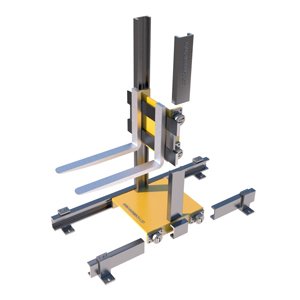
The beauty of the two-rail, four-bearing arrangement is that it can be used in any orientation.
Turn the system on its side and it can provide horizontal linear movement.
Use it vertically and it can support lifting mechanisms (think forklift trucks).
Extend the rails and bearings into a telescopic arrangement and it can offer a full pull-out in a surprisingly compact space.
Introduce a cantilevered load and the same basic principles of bearing spacing, load distribution and moment balance still apply.
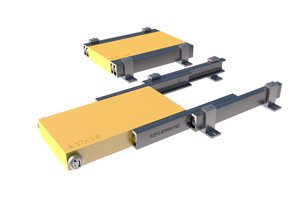
The same components can be optimised for each application through careful engineering. This is one of the reasons combined roller bearings are used in such a wide range of machinery – from material handling and automation equipment to lifting systems and heavy industrial applications. View our range of application examples.
And then things get really big
One of the most incredible things about combined roller bearing systems is how far the same basic engineering principle can be scaled. From the smallest 52.5mm diameter bearing to the largest 390mm “Jumbo” bearing, the concept remains the same.
This simple arrangement was used in a cantilevered lifting mechanism to move the 50-tonne wing of an Airbus A380. That’s quite a leap from the simple four-bearing arrangement we started with.
Simple doesn’t mean unsophisticated
Sophisticated machinery doesn’t require complicated components.
Combined roller bearings handle both radial and axial loads in a single unit. They provide a robust linear motion system which can be engineered to suit a variety of applications.
Two rails and four bearings may not look particularly complicated, but when you start considering radial loads, axial guidance, moment loads, bearing spacing and contact pressure, there’s considerably more going on than first meets the eye.
And that’s the clever part – the performance comes from getting the engineering fundamentals right, not from overcomplicating the system.
For applications where reliable, heavy-duty linear movement is required, that combination of simplicity, scalability and load-handling capacity is what makes combined roller bearings such an effective solution.
How Euro-Bearings can help
Getting the bearing arrangement right starts with understanding the application.
Euro-Bearings can help you work through the engineering requirements, from load and moment calculations to bearing selection, rail configuration and bearing spacing. There’s also an online calculator to guide you together with plenty of application examples.
Whether you’re designing a new linear motion system or looking to improve an existing one, our technical team can help identify a combined roller bearing solution suited to the loads and operating conditions involved.
With a broad range of standard and specialist bearings, rails and accessories available, Euro-Bearings can provide both the components and the engineering knowledge to help turn the concept into a practical linear motion system.