Four Bearings, Two Rails, 50 Tonnes: The Engineering Behind It

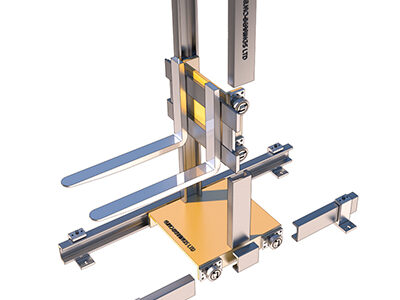
combined roller bearing application

At first glance, a heavy-duty linear motion system can look surprisingly simple – just two rails and four combined roller bearings to make a moving system.
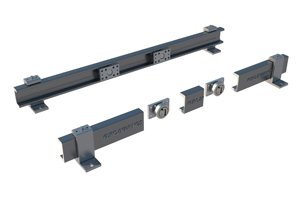
horizontal linear motion application

Surely that’s too simple to move a load weighing several tonnes, let alone tens of tonnes. Yet this basic arrangement is at the heart of some remarkable linear motion systems.

So what is going on? The answer is load management.

It’s not just about carrying the weight

When we think about a linear bearing, it is tempting to only think about load capacity. If a carriage weighs 10 tonnes, surely the solution is to simply specify bearings capable of carrying 10 tonnes?
Not quite. In a linear motion system, the bearings can be dealing with several different forces at the same time. There may be a vertical load from the weight of the equipment, horizontal forces from wind or wave loading, forces from asymmetric loading and moments created by a cantilevered arrangement.

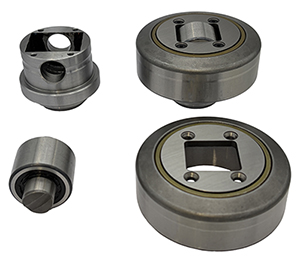
That’s where the combined roller bearing comes into its own. It incorporates radial and axial rollers in a single unit. The radial roller carries the principal load while the axial roller provides lateral guidance against the web of the rail.

The result is a compact bearing that can both support a load and guide the movement.

Why two rails and four bearings work so well

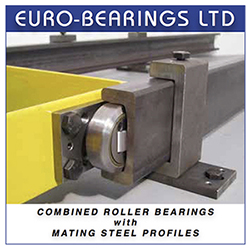
The classic arrangement uses two parallel rails with two combined roller bearings running inside each rail.

The radial rollers run along the flange of the rail, supporting the main load. The axial rollers run against the web of the rail, controlling lateral movement.
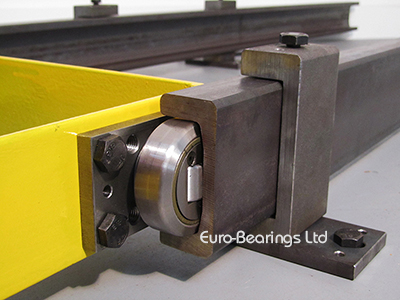
The lateral guidance provided by the axial roller ensures the carriage moves smoothly forwards and backwards and prevents it from moving sideways (“crabbing”) as it travels.

So, although there are only four bearings, each bearing is doing more than simply carrying a proportion of the weight. Each bearing unit works to provide both load support and guidance.

And that’s where the engineering gets interesting.

The Centre of Gravity changes everything

If the load is located in the middle of the four bearings, the forces will be distributed relatively evenly.

Now move the load towards one end. The weight hasn’t changed, and the bearings haven’t changed, but the forces within the system have.

The offset load creates a moment, increasing the load on some bearings while reducing it on others. In cantilevered applications, where the centre of gravity extends beyond the bearings, the additional loads can be significant.

The obvious solution is to increase the size of the bearings to accommodate these additional forces. However, the location of the bearings plays an equally important role in the design. Increasing the distance between the bearings helps to manage the cantilevered load by providing a larger opposing moment arm. Optimising the bearing arrangement can therefore be a better solution when space, weight and cost are critical.

It’s all about Contact Pressure

Another important consideration is the contact between the combined roller bearings and the rail.

The bearing may have an impressive load rating, but the capacity of the system is actually limited by the rail. The forces on the bearings have to be transferred to the rail through relatively small contact areas. This is where Hertzian contact pressure becomes important.

Designing the system therefore involves looking at the load capacity of the bearings when used in conjunction with the rails. The number of bearings, bearing spacing, rail size, applied load and load distribution all have an influence on the contact pressure.

The allowable Hertzian pressure is determined by the steel grade of the rails.

Four bearings can be remarkably versatile
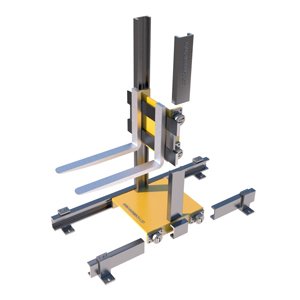
horizontal and vertical system
Combined roller bearings can be used horizontally and vertically

The beauty of the two-rail, four-bearing arrangement is that it can be used in any orientation.

Turn the system on its side and it can provide horizontal linear movement.

Use it vertically and it can support lifting mechanisms (think forklift trucks).

Extend the rails and bearings into a telescopic arrangement and it can offer a full pull-out in a surprisingly compact space.

Introduce a cantilevered load and the same basic principles of bearing spacing, load distribution and moment balance still apply.
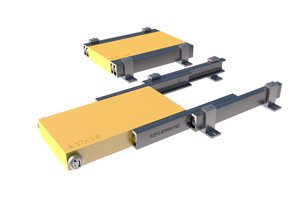
Telescopic heavy duty linear motion
This telescopic system allows full extension


The same components can be optimised for each application through careful engineering. This is one of the reasons combined roller bearings are used in such a wide range of machinery – from material handling and automation equipment to lifting systems and heavy industrial applications. View our range of application examples.

And then things get really big

One of the most incredible things about combined roller bearing systems is how far the same basic engineering principle can be scaled. From the smallest 52.5mm diameter bearing to the largest 390mm “Jumbo” bearing, the concept remains the same.

This simple arrangement was used in a cantilevered lifting mechanism to move the 50-tonne wing of an Airbus A380. That’s quite a leap from the simple four-bearing arrangement we started with.

Simple doesn’t mean unsophisticated

Sophisticated machinery doesn’t require complicated components.

Combined roller bearings handle both radial and axial loads in a single unit. They provide a robust linear motion system which can be engineered to suit a variety of applications.

Two rails and four bearings may not look particularly complicated, but when you start considering radial loads, axial guidance, moment loads, bearing spacing and contact pressure, there’s considerably more going on than first meets the eye.

And that’s the clever part – the performance comes from getting the engineering fundamentals right, not from overcomplicating the system.

For applications where reliable, heavy-duty linear movement is required, that combination of simplicity, scalability and load-handling capacity is what makes combined roller bearings such an effective solution.

How Euro-Bearings can help

Getting the bearing arrangement right starts with understanding the application.

Euro-Bearings can help you work through the engineering requirements, from load and moment calculations to bearing selection, rail configuration and bearing spacing. There’s also an online calculator to guide you together with plenty of application examples.

Whether you’re designing a new linear motion system or looking to improve an existing one, our technical team can help identify a combined roller bearing solution suited to the loads and operating conditions involved.

With a broad range of standard and specialist bearings, rails and accessories available, Euro-Bearings can provide both the components and the engineering knowledge to help turn the concept into a practical linear motion system.

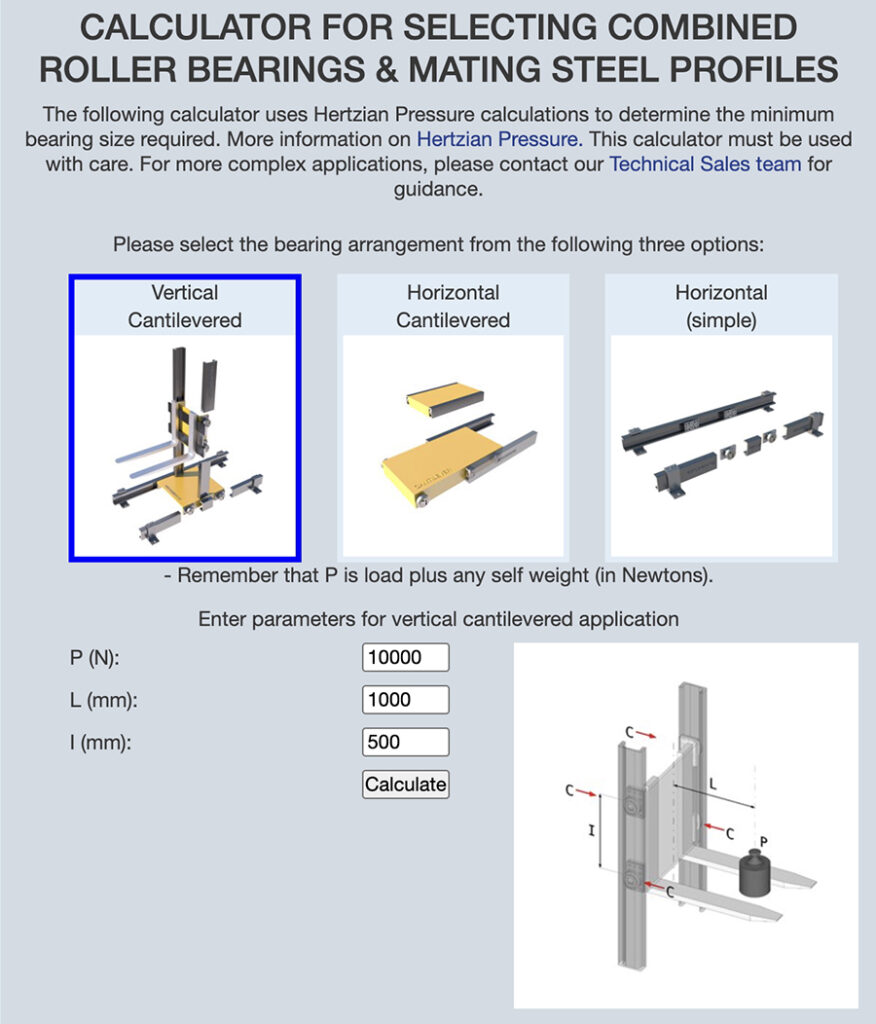
Combined Roller Bearings – Interactive Calculator

The latest addition to our website is a calculator that suggests a minimum bearing size according to the application, loads and bearing centres. The calculator is fully interactive and provides a link to all the products for the suggested size.

Image of Combined Roller Bearing Calculator

Select from a simple horizontal arrangement where the number of bearings can be chosen, or vertical and horizontal cantilevered applications. The calculator allows the distance between the bearings to be varied so that the design can be optimised.

For applications involving I sections or where the loads are particularly large, our technical sales team are on hand to help.

Comprehensive Guide to Combined Roller Bearing Selection, Set Up and Use

Euro-Bearings Ltd specialises in bearings for linear motion and can offer technical support when designing and specify products. With over 40 years’ knowledge of combined roller bearings, you can be sure that you are asking the experts.

How to use Combined Roller Bearings?

combined bearings and rails

Combined Roller Bearings were originally designed for forklift trucks. The assembly consists of two bearings in one, hence “combined”. The radial bearing carries the main load whilst the smaller axial roller resists any side load to help keep the system running true.

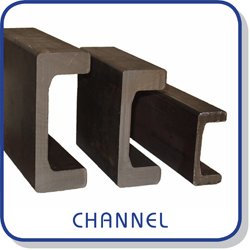
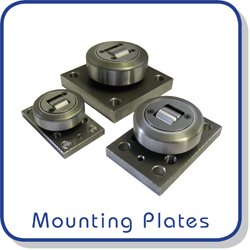
A simple horizontal application requires just two special profiled rails and four standard bearings. The bearings can be supplied welded to mounting plates so they can be bolted into place. The combined roller bearings are available from ø52.5mm to ø390mm making them suitable for loads of just ten kilograms right through to tens of tonnes.

More complex applications include vertical, telescopic and cantilevered arrangements, and they can even be used on all 3 axes to make an XYZ machine. See our application examples for inspiration.

How to select the size?
Every application is different and it is important to check the loads to ensure the correct bearing is specified. In some instances it makes sense to use more rails or bearings to share the load, for example on a vehicle chassis, rather than simply increasing the size of the bearing.

The critical factor is the Hertzian Pressure which is the point load exerted on the profiled rails by the bearings. This force must be limited to prevent the deformation of the rails. The Hertzian Pressure can be calculated using Moment-Balance. In most instances, simple formulae (given on our website) can be used to calculate the force on the bearings and the size of bearing can be selected from our Hertzian Pressure table.

Our technical sales team can support you with this together with design recommendations.

How to set up the rails?
Setting up the system accurately will ensure that the Combined Roller Bearings operate to the best of their ability. Ideally the rails should be absolutely parallel with a clearance between the bearing and rail of 0.3mm to 1.0mm. It is important to test the clearance of the system over the entire length to ensure the axial rollers do not bind in use.

The rails are made from S450J2 steel which is similar to S355 structural steel. The rails can be welded or bolted into place. If it is difficult to set up the system accurately then it can be useful to weld tabs with slotted holes onto the rails to facilitate more accurate adjustment.

Should further adjustment be required, then our eccentric adjustable or shim adjustable bearings can be specified, or the mounting plates can be shimmed from behind.

How to weld the bearings?
The combined roller bearings incorporate a weldable hub made from C22E. The unit does not have to be disassembled for welding, but heat from the weld should be kept to a minimum. The hole into which the bearing is fitted should be 50 to 100 microns larger than the diameter of the hub. It is important to ensure the axial roller is orientated correctly before welding the back using a continuous 45º weld fillet. Normal mild steel (non-alloy) welding techniques can be used. Alternatively the bearings can be supplied pre-welded to mounting plates for ease of assembly.

How to set up the adjustable bearings?
The eccentric and shim adjustable bearings have adjustable axial rollers to alter the height (h) of the bearings. The eccentric type has a splined shaft which can be finely adjusted to achieve the required clearance. There is a video showing how to do this on our website. The height of the shim adjustable type can be altered by placing shims behind the axial roller. When the final height is achieved, the screws should be thread locked to ensure they are secure.

How to protect the Bearings and Rails?
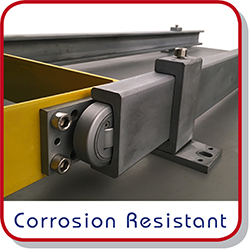
In harsh environments it might be necessary to protect the bearings from rust. This can simply be in the form of shielding or an anti-rust spray, or it may be necessary to coat the bearings to provide corrosion resistance.

The bearings can be supplied with Thin Dense Chromium (TDC) plating which offers a high level of corrosion protection. This is available for all sizes and the mounting plates can be coated too.

The rails can be painted or galvanised to offer protection, but the surface in contact with the bearings must remain bare as the force exerted by the bearings is likely to damage these coatings. The bare steel can be lightly oiled to prevent rust. Alternatively, if full corrosion resistance is required, the rails can be TDC coated over their entire surface.

How to grease and maintain the Bearings?
In a dry environment, such as a warehouse, the rails and bearings can be lightly oiled to keep the surfaces free from rust.

The bearings should be inspected and re-lubricated as required every 6 months. The standard bearings (apart from the smallest 4.053 bearing) have a lubrication hole which is plugged with a grub screw.

If the bearings are in continuous use or harsh conditions, they should be checked more frequently.

A grade 3 bearing grease should be used (e.g. Shell Gadus).

How to replace the bearings?
Should the bearings need to be replaced, the screws holding the bearing to the weldable hub can be undone and a new bearing slid on. A video on our website shows this procedure. The bearing needs to be square to the hub for ease of assembly.

If the bearing is welded to a mounting plate, the whole bearing and plate unit can be easily replaced. There is a standard range of rectangular and square plates, or alternatively a custom plate can be specified.

How fast can the Combined Roller Bearings travel?
The linear speed should less than 1.1m/s for optimum performance. For short intervals and moderate loads, a maximum speed of 1.5m/s is permitted but this may affect the service life.

When to specify Precision (PR) Combined Roller Bearings?
The precision bearings offer a tighter tolerance between the bearings and the rails. In most applications the standard bearings will suffice, but in some cantilevered applications it may be preferable to have a tight tolerance to limit the play in the system.

When to specify High Temperature Bearings?
The standard combined roller bearings can be used for temperatures of up to 80ºC. When the temperature is continuously above 80ºC, we recommend the use of High Temperature (HT) bearings. The HT bearings can operate in temperatures up to 200ºC.

What is S450J2 Steel?
S450J2 is a non-alloy steel that has been developed specifically for use with bearings. The addition of Niobium (Nb) and Vanadium (V) improves both the tensile strength and yield strength which increases the allowable Hertizian Pressure (point load exerted by the bearing).

What seals are used?
The majority of the combined roller bearings feature a ZRS seal which is a metal-rubber hybrid seal. The seals help to prevent dust, water and debris from entering the bearing and retain the grease inside.

What are the Benefits of Combined Roller Bearings?
There are many benefits to Combined Roller Bearings, with their versatility probably being the main one.

  • Combined Roller Bearings are used with matching C or I section profiled rails to provide a simple yet versatile linear motion system that can be used in many applications and environments.
  • The Combined Roller Bearing handles both the axial and radial forces in one unit hence reducing the number of working parts required.
  • The axial roller runs on the web of the steel to provide lateral guidance. This helps to keep the slide running true and prevents jamming or crabbing.
  • The bearings and rails can be used horizontally and vertically, and can also be arranged telescopically in both orientations to allow for full extension.
  • The bearings can be supplied pre-welded to a mounting plate and then simply bolted on for ease of assembly. Alternatively they can be welded directly to the structure for a more compact arrangement.
  • The system can be used in harsh environments and offers good resistance to dirt. High temperature bearings can be specified.
  • The Combined Roller Bearings can be coated to provide corrosion resistance.
  • A precision (PR) version is available for applications requiring higher positional accuracy.
  • Combined Roller Bearings offer a robust heavy duty linear system at a reasonable price which is easy to set up and maintain.

What applications can Combined Roller Bearings be used for?
Typical applications for combined roller bearings include:

  • Oil drilling and exploration equipment
  • Marine cable and pipe-laying equipment
  • Palletisers and packing machines
  • Goods & vehicle lifts
  • Material handling equipment
  • Furnace chargers/dischargers
  • Concrete and aggregate conveyors
  • Brick and concrete block making machines
  • Machine tool positioning and storage
  • Agricultural equipment
  • Specialised vehicles and trailers
  • Theatre and film applications
  • Medical equipment
  • Forklift truck attachments
  • Warehouse automation

A range of application examples are shown on our website including cantilevered, 1 and 2 stage telescopic, and full extension arrangements.

Want to find out more? Or ask another question? Contact our Technical Sales team.