Four Bearings, Two Rails, 50 Tonnes: The Engineering Behind It

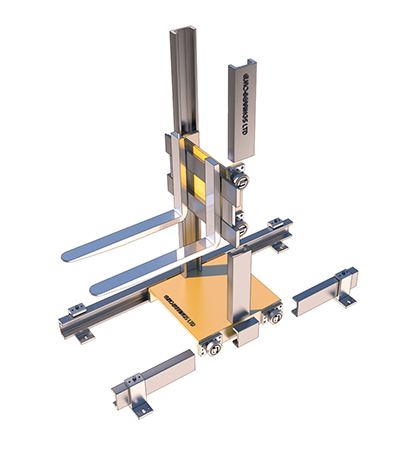
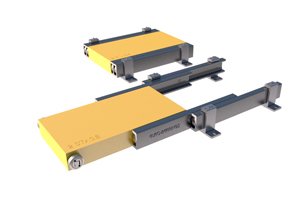
combined roller bearing application

At first glance, a heavy-duty linear motion system can look surprisingly simple – just two rails and four combined roller bearings to make a moving system.
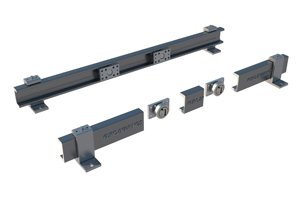
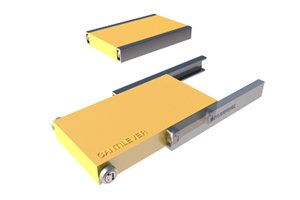
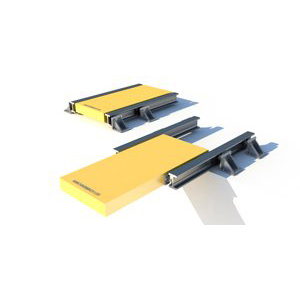
horizontal linear motion application

Surely that’s too simple to move a load weighing several tonnes, let alone tens of tonnes. Yet this basic arrangement is at the heart of some remarkable linear motion systems.

So what is going on? The answer is load management.

It’s not just about carrying the weight

When we think about a linear bearing, it is tempting to only think about load capacity. If a carriage weighs 10 tonnes, surely the solution is to simply specify bearings capable of carrying 10 tonnes?
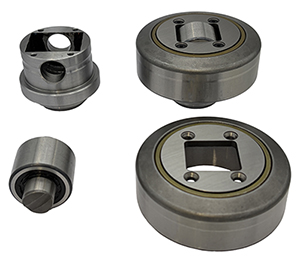
Not quite. In a linear motion system, the bearings can be dealing with several different forces at the same time. There may be a vertical load from the weight of the equipment, horizontal forces from wind or wave loading, forces from asymmetric loading and moments created by a cantilevered arrangement.

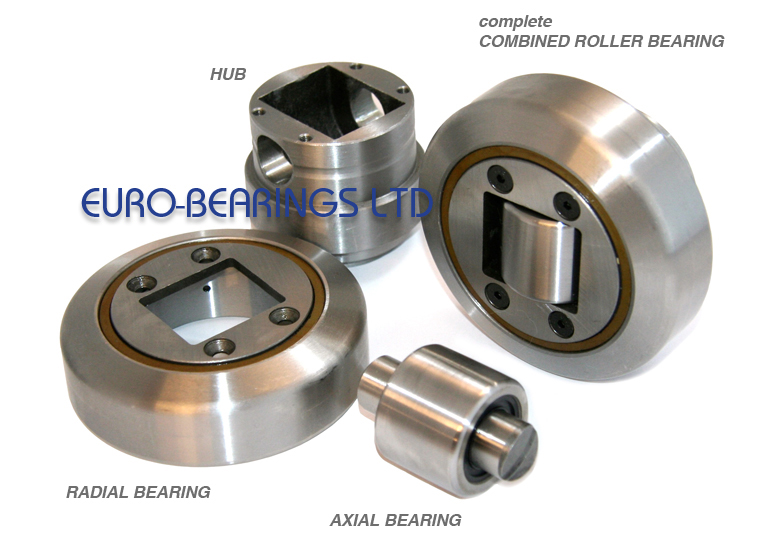
That’s where the combined roller bearing comes into its own. It incorporates radial and axial rollers in a single unit. The radial roller carries the principal load while the axial roller provides lateral guidance against the web of the rail.

The result is a compact bearing that can both support a load and guide the movement.

Why two rails and four bearings work so well

The classic arrangement uses two parallel rails with two combined roller bearings running inside each rail.

The radial rollers run along the flange of the rail, supporting the main load. The axial rollers run against the web of the rail, controlling lateral movement.
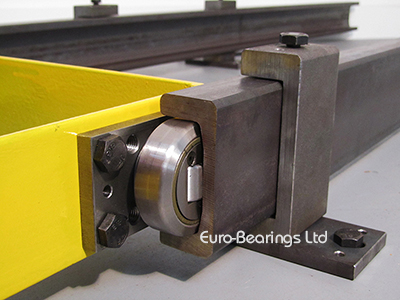
The lateral guidance provided by the axial roller ensures the carriage moves smoothly forwards and backwards and prevents it from moving sideways (“crabbing”) as it travels.

So, although there are only four bearings, each bearing is doing more than simply carrying a proportion of the weight. Each bearing unit works to provide both load support and guidance.

And that’s where the engineering gets interesting.

The Centre of Gravity changes everything

If the load is located in the middle of the four bearings, the forces will be distributed relatively evenly.

Now move the load towards one end. The weight hasn’t changed, and the bearings haven’t changed, but the forces within the system have.

The offset load creates a moment, increasing the load on some bearings while reducing it on others. In cantilevered applications, where the centre of gravity extends beyond the bearings, the additional loads can be significant.

The obvious solution is to increase the size of the bearings to accommodate these additional forces. However, the location of the bearings plays an equally important role in the design. Increasing the distance between the bearings helps to manage the cantilevered load by providing a larger opposing moment arm. Optimising the bearing arrangement can therefore be a better solution when space, weight and cost are critical.

It’s all about Contact Pressure

Another important consideration is the contact between the combined roller bearings and the rail.

The bearing may have an impressive load rating, but the capacity of the system is actually limited by the rail. The forces on the bearings have to be transferred to the rail through relatively small contact areas. This is where Hertzian contact pressure becomes important.

Designing the system therefore involves looking at the load capacity of the bearings when used in conjunction with the rails. The number of bearings, bearing spacing, rail size, applied load and load distribution all have an influence on the contact pressure.

The allowable Hertzian pressure is determined by the steel grade of the rails.

Four bearings can be remarkably versatile
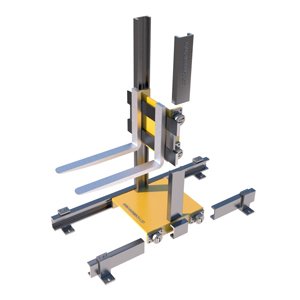
horizontal and vertical system
Combined roller bearings can be used horizontally and vertically

The beauty of the two-rail, four-bearing arrangement is that it can be used in any orientation.

Turn the system on its side and it can provide horizontal linear movement.

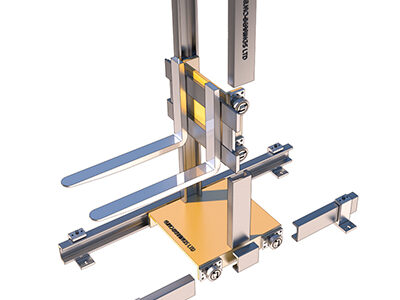
Use it vertically and it can support lifting mechanisms (think forklift trucks).

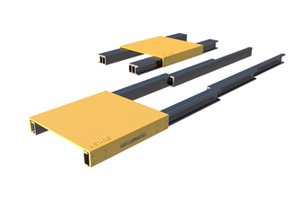
Extend the rails and bearings into a telescopic arrangement and it can offer a full pull-out in a surprisingly compact space.

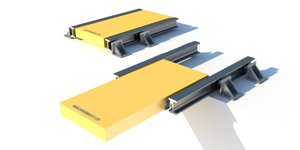
Introduce a cantilevered load and the same basic principles of bearing spacing, load distribution and moment balance still apply.
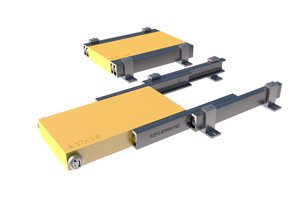
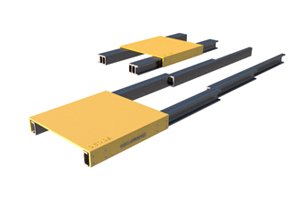
Telescopic heavy duty linear motion
This telescopic system allows full extension


The same components can be optimised for each application through careful engineering. This is one of the reasons combined roller bearings are used in such a wide range of machinery – from material handling and automation equipment to lifting systems and heavy industrial applications. View our range of application examples.

And then things get really big

One of the most incredible things about combined roller bearing systems is how far the same basic engineering principle can be scaled. From the smallest 52.5mm diameter bearing to the largest 390mm “Jumbo” bearing, the concept remains the same.

This simple arrangement was used in a cantilevered lifting mechanism to move the 50-tonne wing of an Airbus A380. That’s quite a leap from the simple four-bearing arrangement we started with.

Simple doesn’t mean unsophisticated

Sophisticated machinery doesn’t require complicated components.

Combined roller bearings handle both radial and axial loads in a single unit. They provide a robust linear motion system which can be engineered to suit a variety of applications.

Two rails and four bearings may not look particularly complicated, but when you start considering radial loads, axial guidance, moment loads, bearing spacing and contact pressure, there’s considerably more going on than first meets the eye.

And that’s the clever part – the performance comes from getting the engineering fundamentals right, not from overcomplicating the system.

For applications where reliable, heavy-duty linear movement is required, that combination of simplicity, scalability and load-handling capacity is what makes combined roller bearings such an effective solution.

How Euro-Bearings can help

Getting the bearing arrangement right starts with understanding the application.

Euro-Bearings can help you work through the engineering requirements, from load and moment calculations to bearing selection, rail configuration and bearing spacing. There’s also an online calculator to guide you together with plenty of application examples.

Whether you’re designing a new linear motion system or looking to improve an existing one, our technical team can help identify a combined roller bearing solution suited to the loads and operating conditions involved.

With a broad range of standard and specialist bearings, rails and accessories available, Euro-Bearings can provide both the components and the engineering knowledge to help turn the concept into a practical linear motion system.

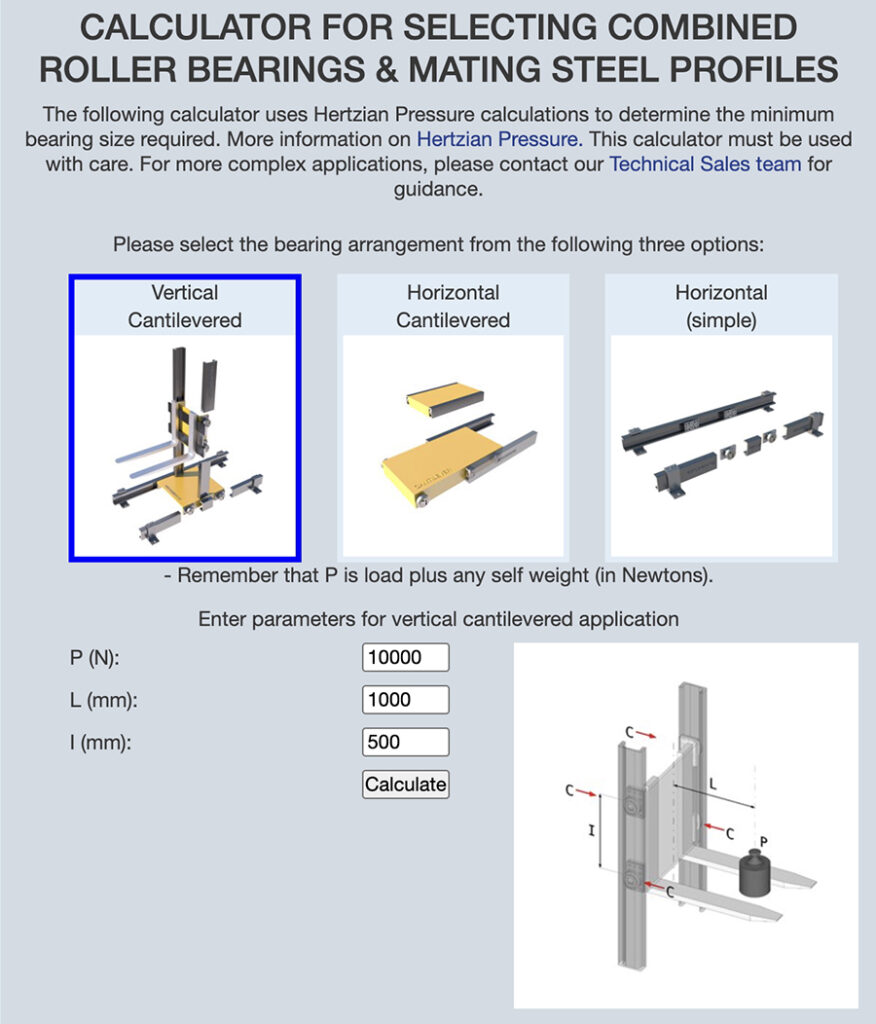
Combined Roller Bearings – Interactive Calculator

The latest addition to our website is a calculator that suggests a minimum bearing size according to the application, loads and bearing centres. The calculator is fully interactive and provides a link to all the products for the suggested size.

Image of Combined Roller Bearing Calculator

Select from a simple horizontal arrangement where the number of bearings can be chosen, or vertical and horizontal cantilevered applications. The calculator allows the distance between the bearings to be varied so that the design can be optimised.

For applications involving I sections or where the loads are particularly large, our technical sales team are on hand to help.

Simply the Best in Linear Motion

Euro-Bearings Ltd’s Combined Roller Bearing range offers one of the most versatile linear motion systems.

combined roller bearing application

The combined roller bearing is a unit consisting of two roller bearings assembled on a weldable hub and it is designed to carry both axial and radial loads. The bearings are used in conjunction with special steel profiles (C or I) to form a heavy duty linear sliding system.

The bearings and rails can be used both horizontally and vertically, and can also be arranged telescopically to allow for full extension. The simplest system consists of just four bearings and two rails. Some application examples are shown below.

With the standard range of bearings offering diameters from 52.5mm to 149mm, and the Jumbo range offering sizes up to 390mm, the system is suitable for a wide variety of applications.

The bearings can be supplied pre-welded to a mounting plate which can then simply be bolted on, or they can be welded directly to the structure for a more compact configuration.

Our knowledgeable technical sales team can offer advice on applications, design, corrosion resistance and sizing. Please call or email to discuss your requirements.

Application Examples for Combined Roller Bearings and Profiled Rails:

horizontal linear motion applicationhorizontal and vertical systemSimple cantilever using combined roller bearings
Simple Horizontal SystemCombined Horizontal / VerticalHorizontal Cantilever
Telescopic heavy duty linear motionThree stage telescopic linear systemcantilevered systems using an I or H section
2 Stage Telescopic System3 Stage Telescopic SystemI Beam Cantilevered System

Multi Purpose Combined Roller Bearings

Combined Roller Bearings were originally designed to be used in forklift truck masts. However, today they are used in a variety of applications (horizontally and vertically) and in a huge range of industries.

The smallest bearing is just 52.5mm in diameter and when used in conjunction with the corresponding steel profile, each bearing offers a load capacity of approximately 550kg. At the top end of the range the largest bearing is 390mm and has a capacity of over 30 tonnes.

The primary benefit of a Combined Roller Bearing over a standard track roller bearing is the integral side thrust roller bearing. This small roller is able to carry lateral loads and ensures free movement of the system.

To make a complete slide you simply need 2 rails and 4 bearings. The bearings can be welded directly to the structure or can be supplied pre-welded to a mounting plate and simply bolted into place. More complex, telescopic systems can be made by using additional rails and bearings to create further stages.

The application examples below show how versatile this sliding system is.


euro combined bearings and channels combined roller bearings forklift horizontal cantilever using combined roller bearings
telescopic combined roller bearings and rails telescopic combinaton bearing application i beam combi bearing cantilevered system

Being so versatile, combined roller bearings can be used in many applications including:Please click an image for more details.

  • Lifting & Handling Equipment
  • Offshore Cable & Pipe Laying
  • Specialised Vehicles
  • Packing Machines
  • Furnace Loaders
  • Agricultural Equipment

If you think you might have an application for Combined Roller Bearings, please contact our technical sales team. We have many years of experience and our team includes Engineers and Designers.

Sliding Gardens

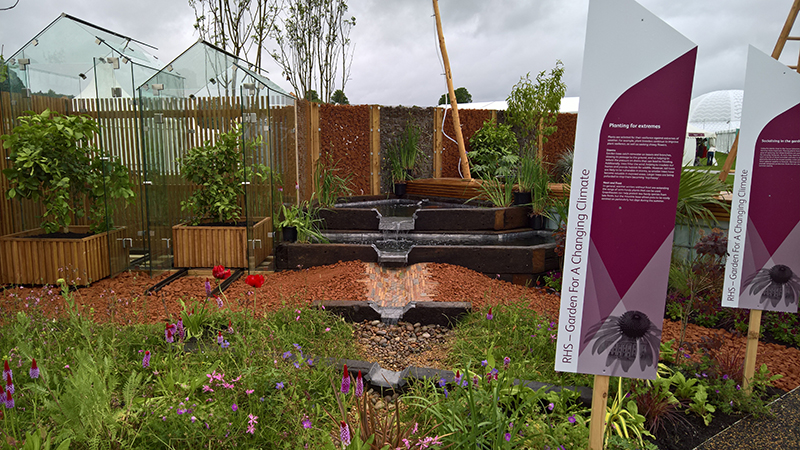
When the Landscape Director from N T Killingley contacted us about sliding a planter in and out of a glasshouse at RHS Chatsworth, our Technical Sales team listened to his specification and suggested various options. Their requirement was a system that was simple to install and robust enough to carry the weight of a laden planter, but most importantly would not cost a fortune as the display was temporary.
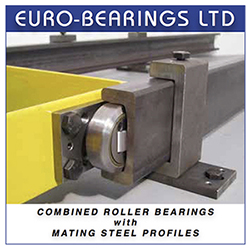
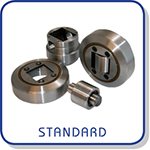
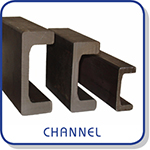
The combined roller bearing system met this criteria. By using the rails upturned, there was very little set up involved and the bearings and mounting plates were simply bolted to the underside of the planter.

The end result was a system that was discreet and could be operated with very little effort. The display formed part of the “Garden for a Changing Climate” at RHS Chatsworth in June 2017 and featured on BBC’s Gardeners World.

The RHS video of the garden can be viewed here. And the BBC Gardeners World episode can be viewed here (approximately 41 minutes in).

If you need help to specify a linear sliding system, please contact us. We have a team of Engineers & Designers who can guide you through both selecting the most suitable product and specifying the correct size.

Photo courtesy of N T Killingley © 2017

Did you know…?

Combined roller bearings can be used in a huge variety of applications. In the simplest arrangement (4 bearings & 2 rails) they can be used to make a forklift mast (vertically), a telescopic slide (horizontally) or just to slide something from A to B.

combined bearings and rails
Combined Roller Bearings and Mating Steel Profiles (Rails)

The main advantage of a combined roller bearing is the small axial roller that helps to keep the system running parallel and prevent it from jamming or crabbing. The combi bearings come complete with a weldable hub so they can be welded directly to your structure or, for ease of maintenance, they can be purchased pre-welded to a mounting plate. This mounting plate is simply bolted on with 4 bolts.

Used together with the mating steel channels (rails), the combined roller bearings offer a simple and cost effective way to make a heavy duty linear slide system. The smallest bearing diameter is 52mm, and the largest Jumbo bearing is 390mm. The rails are available in both C and H (or I) sections.

What Products are Available?

Standard Range
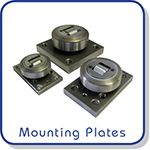
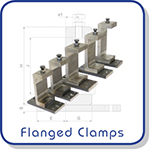
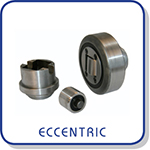
standard combined roller bearings rails for combi bearings mounting plates for combined bearings flanged clamps for CR rails eccentric adjustable CR bearings
Precision Range Jumbo Range
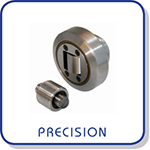
standard combined roller bearings rails for combi bearings mounting plates for combined bearings flanged clamps for CR rails eccentric adjustable CR bearings

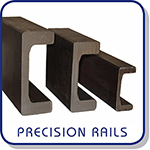
Precision Range: For heavy duty applications requiring high precision, the Precision Combined Roller Bearings offer a reduced clearance between the bearing & the rail and consequently minimise the play in the system. The rail is machined in the web and the bearing diameter is increased to match this, with a tolerance of 0.2mm – 0.4mm.Click on an image to visit the relevant webpage.

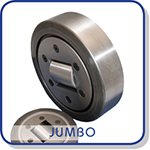
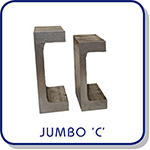
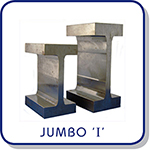
Jumbo Range: For ultra heavy duty applications, the Jumbo bearings can offer an affordable solution.

Corrosion Resistance: In some environments (e.g. Offshore) it can be beneficial to use a corrosion resistant system. The Thin Dense Chromium coating withstands salt spray and can considerably improve the operating life. We can offer all of the ranges with coating.

Please visit our website for full details. Datasheets & pdf catalogues are available to download.

Advantages

+ Very heavy load capacities. See Hertzian Pressure for system capability.

+ Side (axial) roller prevents crabbing. Channel (rail) is self supporting in many applications.

+ Easy to engineer, assemble and set up. Low maintenance.

+ Tolerant of dirty / dusty environments.

+ Bearing diameters from 52mm to 390mm.

Applications

– Access Equipment

– Handling Equipment, including forklift trucks & scissor lifts

– Palletising Machines

– Lifts for goods, personnel and wheelchairs

– Paying Out Systems


– Agricultural Machinery

– Primary Food Processing Equipment

– Furnace Loading Equipment

– Production Lines

– And lots more…

Why Euro-Bearings Ltd?

– Large UK-based stock of Combined Roller Bearings

– Over 30 years in the industry

– Always speak to Technical Sales

– Fast delivery

– Family business who value their customers

– Ability to offer custom plates or special diameter bearings

Combined Roller Bearings

Our Combined Roller Bearings consist of a radial bearing, an axial (face) bearing and a weldable hub. The main radial bearing can take very high loads and the axial roller takes side loads and prevents the bearing from crabbing in the channel. Used in conjunction with their mating steel channel it is possible to design and build a heavy duty linear sliding system, for either horizontal or vertical motion. More complicated systems can be built using the bearings and channel to create telescopic and cantilevered solutions. We can help you to select the correct size for your application. Our bearings range in size from an outer diameter of 52.5mm all the way up to 390mm (Jumbo CR range).

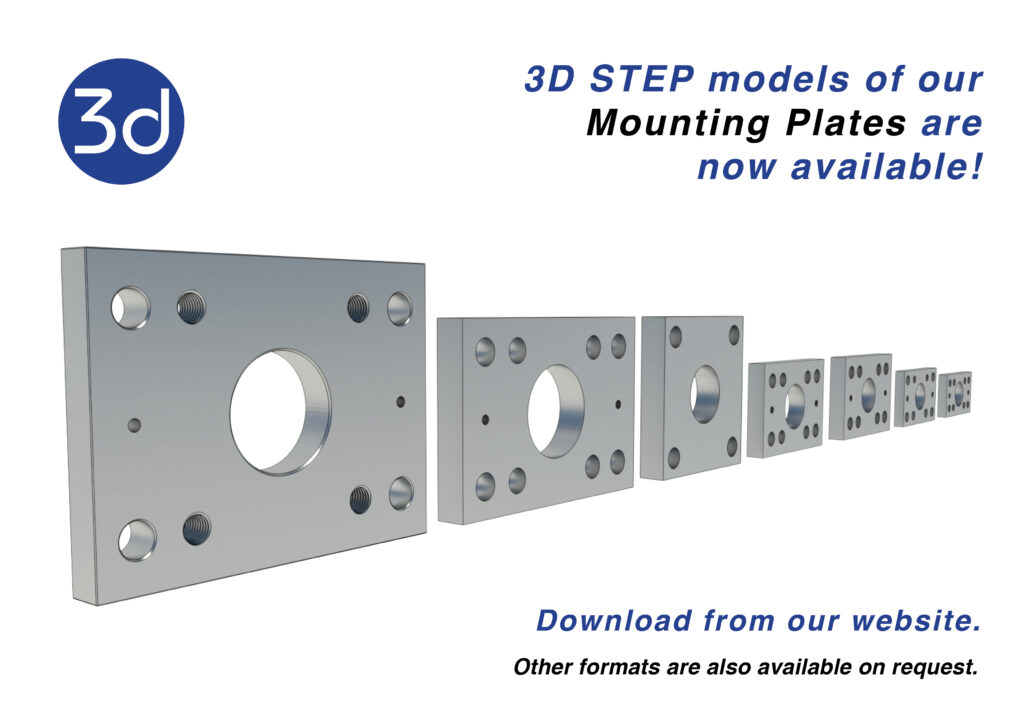
The hub of the bearing is weldable so that the bearing can either be welded directly to a structure or to a mounting plate. We keep the standard mounting plates on stock and we can supply the bearing welded to its plate. The standard mounting plates have both threaded holes and thru holes so that the plate can be fixed from the front or the back. We can fabricate bespoke mounting plates to your design.

We also offer a range of combined roller bearings that a have an eccentric adjustable face roller. The height of the face roller can be varied by removing the front face plate and rotating the shaft of the axial bearing, the ends of which are splined. More information on our website here: Eccentric Adjustable CR Bearings

If your application does not require the axial (face) roller then you could use our Radial Bearings which offer all the advantages of our Combined Roller Bearings and are designed to run in the same steel channels.